
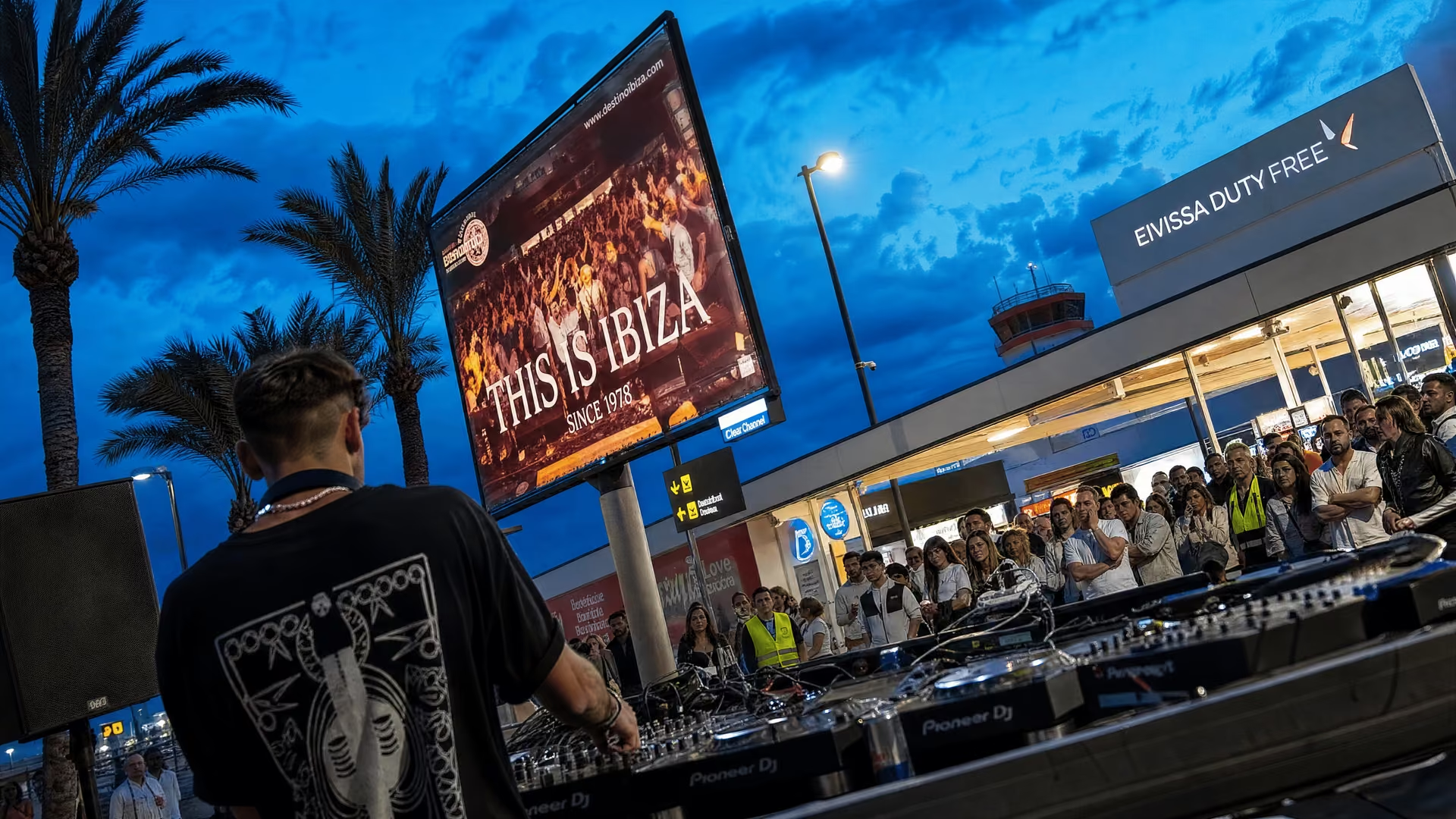



A DJ in Ibiza Airport’s duty-free area went viral as Aena presented an expansion that could nearly double capacity on an island under pressure.

A DJ performance in Ibiza Airport’s duty-free area drew more than 210,000 Instagram views on 13 July 2026, turning a commercial activation into a public argument about tourism, airport expansion and who decides Ibiza’s limits. The episode, examined in this report on the duty-free DJ and Aena’s airport expansion, arrived days after Aena presented local institutions and business groups with plans for a project that could virtually double the capacity of the Codolar airport.
The DJ clip made the airport’s commercial role impossible to miss
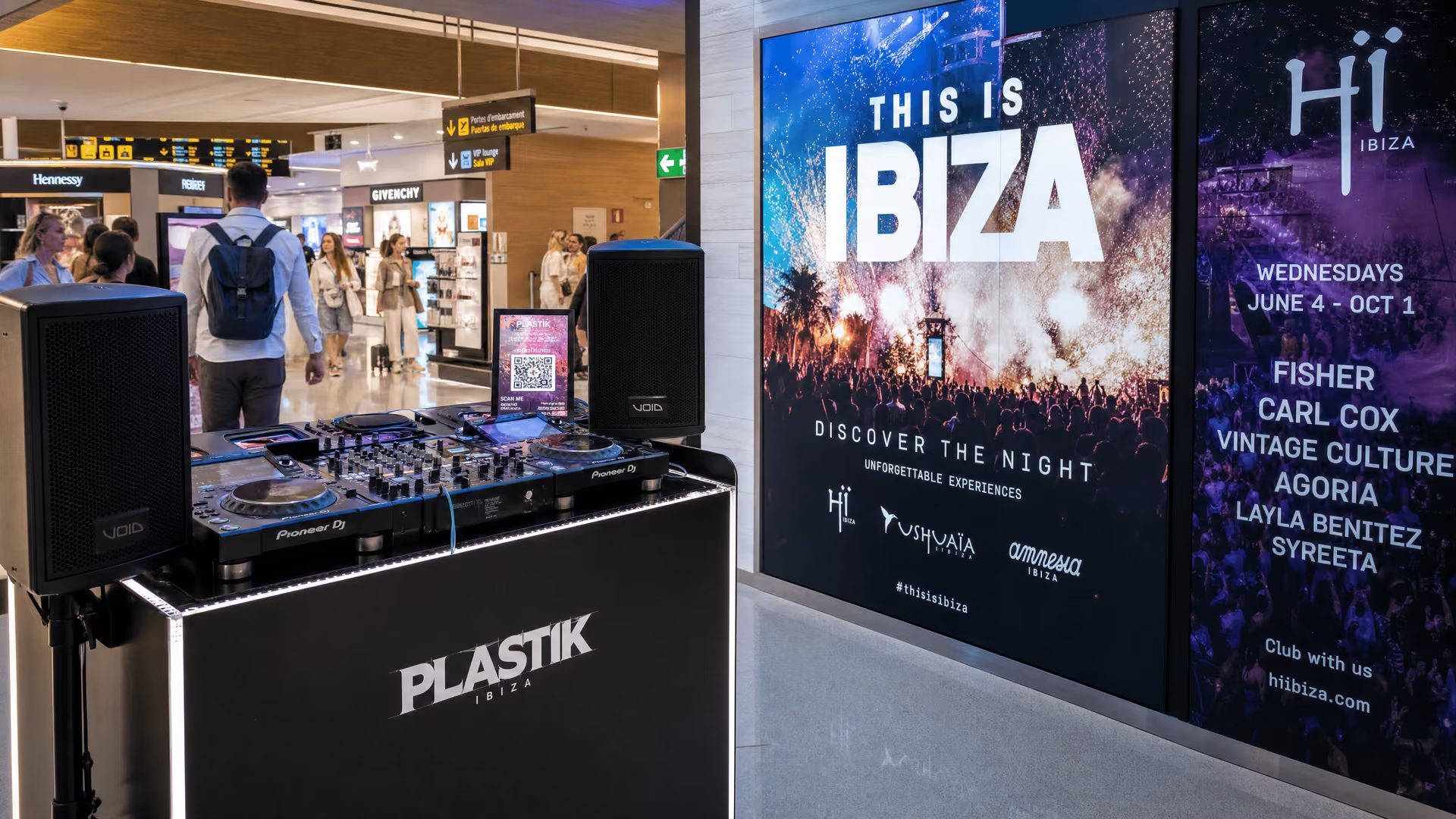
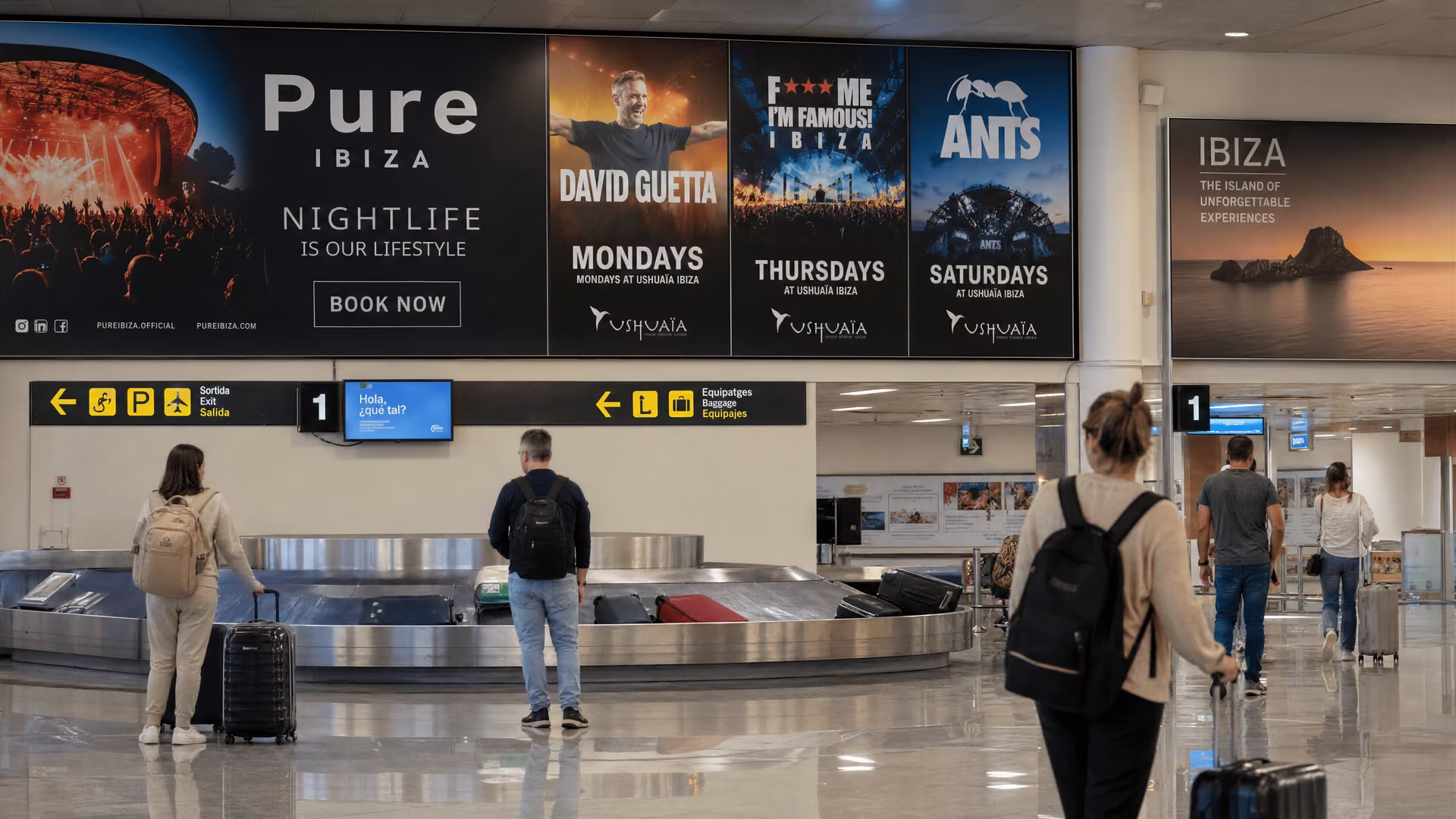
Mercè Molinas arrived at Ibiza Airport during July and encountered a DJ playing inside the duty-free area. She recorded the moment and published it on Instagram on 13 July. The video quickly became the most visible sign of a wider change already apparent to passengers: advertising for Ibiza’s nightclubs had spread through the arrivals and baggage-collection areas.
The significance was not simply that music was playing in an airport shop. The performance made the airport look like an extension of the island’s nightlife economy at precisely the moment when Aena was asking Ibiza’s political and business establishment to accept a major increase in airport capacity. The contrast was difficult to overlook: the terminal was being presented as a commercial showcase while the island was being asked to debate whether its infrastructure and environment could absorb more pressure.
The episode brought three separate questions together:
- How far can commercial advertising and entertainment go inside a critical public-facing infrastructure?
- Why is Aena promoting a project that could almost double the airport’s capacity when access roads are already described as congested?
- How much influence do Ibiza’s institutions have over decisions ultimately governed by Aena and the Spanish state?
The reaction was strong enough for Ibiza’s island government to demand that Aena cancel the Sunday DJ sessions that turned the duty-free store into what critics described as a nightclub. Aena responded that the promotion had been organised by Avolta, the concessionaire operating the commercial space. That distinction matters, but it does not remove the underlying issue: the activation took place inside an airport controlled by Aena and became a public symbol of the way Ibiza is being marketed.
A commercial activation became part of the airport debate
The airport’s advertising was already visible before the DJ appeared. The Ara Balears account describes the arrivals and baggage areas as heavily associated with Ibiza’s discotheques, making the terminal function as a first point of contact with the island’s nightlife brand. The performance gave that commercial relationship a physical presence: passengers were no longer only passing advertising on a wall or screen, but encountering a live event inside the duty-free zone.
That is why the episode resonated beyond the question of taste. Airports are commercial environments, but they are also critical infrastructure. In Ibiza, the airport is the main gateway through which the seasonal population arrives and leaves, and its operation affects residents, workers, visitors and the island’s wider transport system. The dispute therefore concerns both the use of a concession space and the public meaning of the airport itself.
The main actors in the episode and the expansion discussion can be separated as follows:
| Actor | What the facts show | Why it matters | Source |
|---|---|---|---|
| Aena | Presented the airport expansion and oversees the airport’s operating framework | Its commercial and infrastructure decisions shape the island’s access point | Aena, the DJ and the airport expansion |
| Consell d’Eivissa | Participated in the expansion meeting and demanded that the DJ sessions be cancelled | It represents the island institutionally but does not control Aena’s final decisions | Ibiza demands an end to the airport duty-free nightclub |
| Avolta | Was identified by Aena as the organiser of the promotion | The concessionaire’s role separates the event’s organisation from Aena’s direct operation | Ibiza demands an end to the airport duty-free nightclub |
The expansion meeting exposed a striking change in position
On 9 July, Aena met with the Consell d’Eivissa, businesses, hoteliers and other island organisations to explain its plans for the airport at the Codolar. The meeting was presented publicly as an expression of consensus. Local political and business representatives, including Pimeef and UGT, accepted the explanation after some had criticised the project the previous day.
The project’s central implication is substantial. According to the source account, the proposed works could virtually double the airport’s capacity. That prospect sits alongside a practical problem that has not been resolved by the meeting: the access roads already experience daily congestion. Increasing the capacity of the aerodrome without explaining how those approaches would cope leaves the most immediate pressure point unanswered.
The architects of Ibiza were the principal dissenting voice described in the account. Their professional body reminded the institutions that architects are the specialists in urban development and warned that an expansion of this scale would increase pressure on an island ecosystem already at its limit. Their intervention challenged the idea that a meeting involving public institutions and business groups amounted to a complete social consensus.
The airport scene and the expansion presentation therefore read as two parts of the same story:
- The DJ performance showed the airport being used as a visible commercial platform for Ibiza’s nightlife economy.
- The expansion meeting presented greater airport capacity as a project capable of winning institutional support.
- The architects’ warning placed the proposal within the island’s existing environmental and infrastructure limits.
- The Consell’s objection to the DJ sessions showed that local political support for the airport’s commercial image is not unconditional.
Aena’s public-private structure explains the distance from local control
The source’s explanation of Aena’s status is central to understanding why the local meeting does not itself determine the airport’s future. Aena is a listed company, but its principal shareholder is Enaire, the public company dependent on Spain’s Ministry of Transport that controls Spanish airspace. Enaire owns 51% of Aena, while investment funds including BlackRock and Vanguard hold the remaining 49%.
That structure gives the Spanish state the final word in ownership terms while leaving Aena operating as a company with a business logic. The article describes Aena as neither wholly private nor wholly public: it governs critical state infrastructure, yet local authorities are not entitled to direct its decisions simply because the airport is located on Ibiza.
The ownership split is the clearest numerical description of that tension:
Aena’s ownership structure
- Enaire, the public shareholder51%
- Investment funds and other private shareholders49%
The source also links Aena’s commercial incentives to the wider Spanish airport network. It argues that the company cannot allow profitable airports to lose money because those revenues help cover losses at dozens of airports that operate at a deficit. Under that model, Ibiza is not only a local transport facility. It is also part of a national network in which the most profitable airports carry financial responsibilities beyond their own island.
The election calendar may delay the most difficult argument
The Ara Balears analysis places the airport dispute inside an electoral timetable. The next municipal and regional elections are described as being ten months away, with May 2027 marked as the politically important date. The article’s calculation is that administrative procedures and paperwork make it unlikely that construction at the Codolar would become visibly disruptive before then.
That does not mean the project has been suspended. The source states that the implementation of Dora III, the Airport Regulation Document, will continue along the path already established. The 9 July meeting may have created the appearance of agreement, but it did not alter the formal process.
The chronology described in the source is short but revealing:
The political calculation is straightforward even if the underlying dispute is not. Local leaders can accept Aena’s explanation now, while the most contentious consequences of the expansion may arrive later. If construction and access problems become more visible after the election, the institutions that endorsed the project will have to explain how the island’s roads, environment and public services are expected to absorb it.
The final decision lies beyond the airport meeting room
The source’s conclusion about power is blunt: Aena will continue with Dora III unless political or popular pressure becomes large enough for an actor with real influence in Spain’s central government to intervene. That places the Consell d’Eivissa and other Balearic institutions in a difficult position. They can object, negotiate and shape public opinion, but they do not possess the decisive authority over Aena’s national infrastructure decisions.
This helps explain why the duty-free DJ became such an effective symbol. A live performance is easy to see, record and share. The ownership structure, airport regulation document and long administrative process are much harder to grasp. Yet the DJ revealed the same governing logic as the expansion plan: the airport is treated as an asset whose commercial and operational value can be increased, while the island’s capacity to absorb that growth remains a separate question.
The episode does not establish that the DJ caused the expansion project, nor that the promotion and the construction plans are formally connected. It shows something more basic. The same airport can be marketed as a stage for Ibiza’s nightlife and defended as critical infrastructure for a growing transport system. For residents, the unresolved issue is whether those two functions can continue expanding together on an island that the source describes as already under pressure.
Readers looking for the factual sequence can reduce the dispute to four questions:
What the Ibiza Airport dispute means
What happened in the duty-free area?
A DJ was playing in Ibiza Airport’s duty-free area during July. Mercè Molinas recorded the scene and published it on Instagram on 13 July 2026.
How widely was the video viewed?
The video accumulated more than 210,000 views on Molinas’s Instagram account, according to the source account.
Who did Aena say organised the promotion?
Aena said the promotion was organised by Avolta, the concessionaire operating the commercial space.
Did the meeting with local institutions change the expansion process?
No. The source states that the implementation of Dora III will continue as planned. It says only major political or popular pressure could lead the Spanish state to consider intervening.
How large could the proposed airport expansion be?
The project is described as one that could virtually double Ibiza Airport’s capacity, although the supplied facts do not provide a precise final capacity figure.
The duty-free DJ explains the airport better than any technical presentation because the performance made its competing roles visible at once: commercial showcase, nightlife advertisement and critical infrastructure. Aena’s expansion plans may continue through the national regulatory process, but the question raised in Ibiza is local and immediate—whether an island already described as saturated should be asked to accommodate more capacity while having so little control over the decision.
Sources
- La dama de acero, por Samaj Moreno (noudiari.es)
- Vuelve el mejor balonmano: el HC Eivissa abre una nueva y ambiciosa temporada (noudiari.es)
- El Govern refuerza el agua de Ibiza con una cuarta línea en la desaladora de Santa Eulària, que licita por 10,3 millones (lavozdeibiza.com)
- Sant Antoni duplica el aparcamiento público gratuito de una de las grandes bolsas del oeste de Ibiza (lavozdeibiza.com)
- El DJ del duty free explica millor que ningú què està passant a l'aeroport d'Eivissa (arabalears.cat)
- La rebel·lió de les últimes sargantanes: "No en quedarà cap en dos o tres anys" (arabalears.cat)
- RESUM IB3 NOTÍCIES CAP DE SETMANA 01/08/2026 (ib3.org)
- Leire Escauriaza i Marc Naranjo, dos gimnastes amb molt de futur (ib3.org)
- Un eclipse sin promoción turística en las islas que duplican su población en verano (eldiario.es)
- La fiebre por el eclipse dispara las reservas en bares, hoteles y 'beach clubs' de Mallorca: "Nos llaman de Indonesia" (eldiario.es)